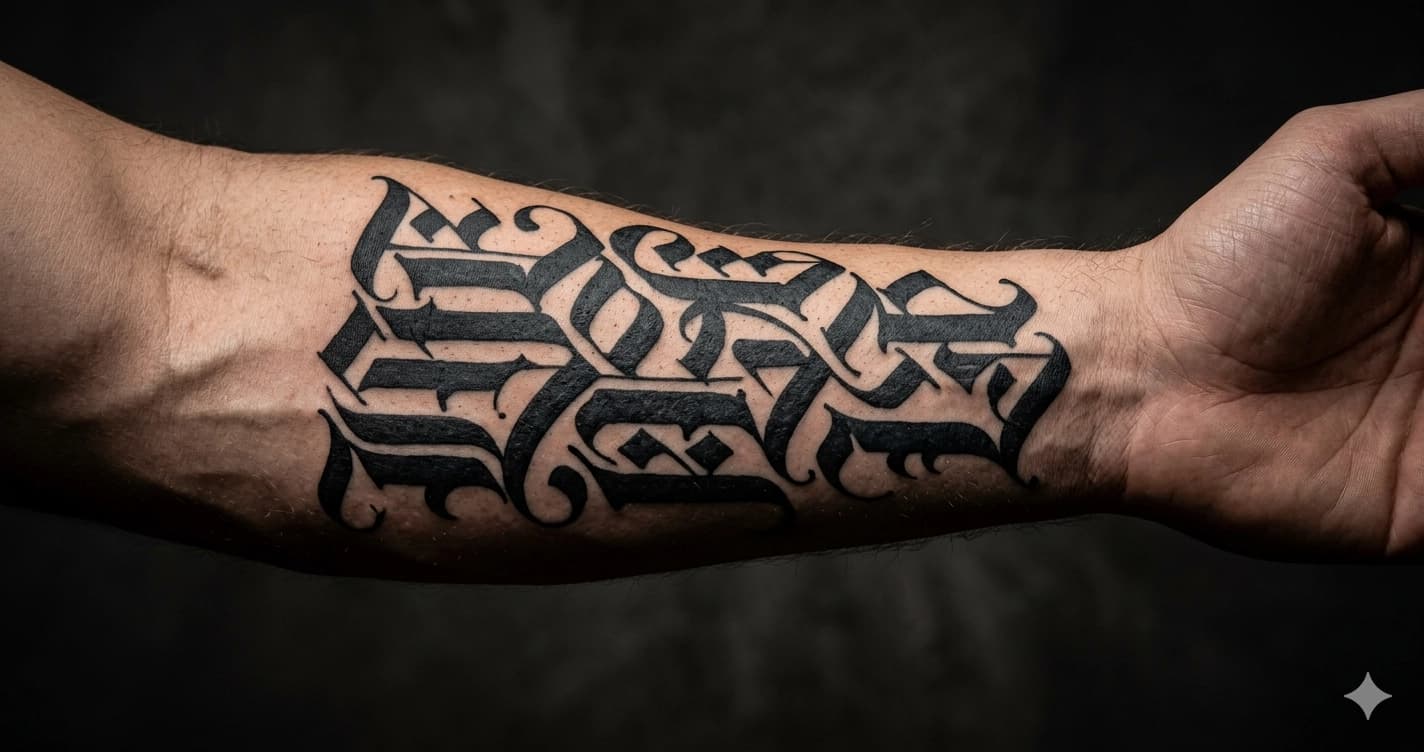
Gothic Fonts for Tattoos — Blackletter Styles, History, and What Actually Ages Well
Gothic lettering in tattoos isn't a trend. It's one of the oldest and most technically demanding traditions in the entire history of tattooing — rooted in Chicano prison culture, adopted by bikers and metal scenes, and now experiencing a serious fine-line revival. The letterforms that seem purely decorative carry 80 years of subcultural weight.
This guide covers the blackletter subfamilies, how each ages on skin, the cultural roots you should know before getting one, and what separates a gothic tattoo font that holds up for decades from one that blurs into an unreadable smear by year five.
Why Blackletter Dominates Tattoo Lettering
Blackletter — the family of scripts that includes Gothic, Fraktur, Old English, and Textura — was the dominant Western script for 400 years. It fell out of everyday use in the early 20th century but never left visual culture. It survived in newspaper mastheads (The New York Times still uses a blackletter nameplate), religious contexts, legal documents, and eventually, tattooing.
The reason blackletter works for tattoos is structural: the letterforms have thick primary strokes and dense ink coverage. Tattoos age by spreading — ink migrates outward through the dermis as immune cells attack pigment particles. A font that relies on thin hairlines will blur into nothing within a few years. Blackletter's weight is a practical advantage, not just an aesthetic one.
The association between blackletter and tattoo culture also has a specific historical origin — and understanding it matters if you're considering this style.
The Chicano Roots of Gothic Tattoo Lettering
The story of gothic lettering in tattoos begins in East Los Angeles in the 1940s and 1950s, not in medieval Europe or heavy metal bands.
Pachuco and Chicano subculture developed ornate, heavily stylized blackletter lettering — called placas (Spanish for "badges" or "license plates") — as identity markers in prisons and barrios across California, Texas, and New Mexico. These weren't decorative choices made from a font menu. They were hand-drawn systems of communication created under severe constraints: makeshift tattoo pens made from sewing needles melted into toothbrush handles, India ink or mascara as pigment.
After La Eme (the Mexican Mafia) formed at Deuel Vocational Institution in 1957, prison tattoo vocabulary became increasingly formalized. Distinct letterforms marked gang affiliation, ranking, and coded messages within closed institutional communities — a parallel visual language that operated entirely on the skin.
The choice of blackletter wasn't arbitrary. Hispanic tattoo artists in Southern California may have gravitated toward blackletter because it was the typeface of the printing presses brought to Mexico by Spanish colonizers — the letterform had been present in Mexican visual culture for centuries before tattoo culture adopted it.
NPR's Code Switch documented how this tradition — developed under conditions of marginalization and incarceration — evolved into one of the most technically respected styles in contemporary tattooing. The placa tradition is now recognized as fine art. Specialist Chicano tattoo artists command significant prices internationally and train in a lineage that traces directly to those prison environments.
Why this matters before you get the tattoo: Gothic lettering in tattoos carries this specific cultural history. Acknowledging its origins — particularly if you're outside the communities that created it — is the kind of context that separates an informed choice from an uninformed one. Many artists also pair these blackletter placas with ornate script swashes; explore our companion Cursive Tattoo Fonts Guide to see how Chicano cursive lettering developed alongside gothic styles.
The Five Blackletter Subfamilies (and What They Mean for Tattoos)
Not all gothic lettering is the same. The blackletter family includes five main subfamilies with distinct visual characteristics and very different implications for skin application.
Textura Quadrata
The oldest and most rigid blackletter style. Textura's tall, narrow letterforms are packed so tightly they resemble woven textile — the name derives from the Latin for "weaving." The vertical strokes are dense, the counters (internal spaces inside letters like 'e' and 'a') are extremely narrow, and the rhythm is relentlessly consistent.
Tattoo implications: Textura is the most visually striking and the most risky for tattoo application. The tight spacing and minimal counter space means ink spread will close up internal spaces within years, turning legible text into dense black blocks. Only recommended at large scale with a tattoo artist experienced in blackletter, who can compensate by artificially expanding spacing in the stencil.
Fraktur
The most recognizable German blackletter style. Fraktur's name comes from the Latin fractus — "broken" — describing the way letterforms appear fractured and pieced back together. More ornate than Textura, with prominent serifs, decorative flourishes, and a better balance between visual weight and internal space.
Tattoo implications: Fraktur offers a strong visual impact with better aging than Textura. The letterforms are complex enough to look distinctive at larger sizes while the counters are more open than Textura. Used extensively in Chicano tattoo tradition and by biker culture. Fraktur-influenced lettering appears in Motörhead's wordmark and countless metal band logos.
Rotunda
Introduced in 12th-century Italy as a variant of Textura, Rotunda trades angular compression for rounded, flowing forms. The letters breathe more. The internal spaces are wider. It feels less medieval and more calligraphic.
Tattoo implications: The most technically forgiving blackletter subfamily for tattoo application. The open counters resist ink closure, the rounded forms age more gracefully, and the letterforms read at smaller scales than Textura or Fraktur. Good for placements that can't accommodate large text — forearms, collar bones, ribcage.
Schwabacher
A transitional style that evolved from Textura in 15th-century Germany under humanist influence from Italy. Schwabacher blends the rigid structure of Textura with more pronounced flourishes and a humanist sensibility. The lowercase 'o' is characteristic — rounded on both sides with angled joins at top and bottom.
Tattoo implications: Less commonly used in tattooing than Fraktur or Old English, but the ornate flourishes and decorative details make it attractive for custom lettering. The decorative elements require careful attention from the tattoo artist — thin flourish strokes are the first thing to blur.
Old English (English Blackletter)
Old English is the adaptation and modernization of blackletter for contemporary use. The canonical reference is Old English Text MT, essentially identical to Cloister Black — designed by Morris Fuller Benton in 1904 and now one of the most ubiquitous fonts on any computer. Cloister Black has been the backbone of Chicano tattoo lettering, gang tattoos, and biker patches for decades.
Tattoo implications: The most widely used gothic font in tattoo culture and the most proven on skin. Old English's letterforms are refined for legibility compared to medieval blackletter, with more open counters and cleaner stroke transitions. The decades of Chicano and biker tattoo tradition mean there's an enormous body of reference for how it ages — and it ages well when done at appropriate weight and scale.
What Makes a Gothic Tattoo Font Age Well (and What Doesn't)
Every tattoo ages. Ink migrates outward through the dermis as the immune system's macrophages attack pigment particles — this process is inevitable and ongoing. The question isn't whether your tattoo will change, but whether the design is built to accommodate that change.
Professional tattoo artists who specialize in lettering increase stencil kerning (spacing between letters) by approximately 10–15% compared to what you'd use in digital design. That gap that looks almost too wide in the stencil is exactly right for skin.
What holds up
Bold stroke weight. Blackletter's primary advantage. The dense ink coverage of a properly weighted gothic letter means there's ink to spare as migration occurs. A letter that's bold enough is readable for decades. A letter with thin strokes — script flourishes, delicate serifs — disappears within years.
Open counters. The spaces inside letters — the hole in 'e', the bowl of 'a', the loop of 'p' — must be generous. If they look barely open in digital format, they'll close completely as ink spreads. The test: if you can't fit a toothpick (visually) in the internal space at the planned tattoo size, it's too tight.
Consistent stroke width. Dramatic thin-to-thick contrast looks beautiful on paper. On skin, the thin parts vanish while the thick parts spread. The result after five years can look like random blobs connected by ghosts. Gothic's inherent weight consistency is an advantage here over calligraphic scripts.
Minimal delicate details. Thin serifs, hairline swashes, and delicate flourishes are the first casualties of ink migration. If the font's character comes from thin decorative details, those details won't be there in year three.
What doesn't hold up
Textura at small sizes. The compressed spacing that makes Textura visually striking becomes its undoing on skin. The negative space between vertical strokes closes, individual letters merge, and the text becomes a band of black.
Script flourishes as structure. When ornamental swashes are the primary design element rather than decoration added to solid letterforms, they fail first. Flourishes detached from the main letterforms leave visible gaps as ink moves.
Anything designed for web or print. Standard design fonts were not engineered for ink migration. Fonts with extensive thin details that look sharp at 12pt on screen require significant modification — or outright rejection — for tattoo application.
The Fine-Line Gothic Revival
Contemporary tattooing is seeing a fine-line gothic revival that seems to contradict everything above — but doesn't quite.
The fine-line gothic style (also called "soft gothic") uses precision linework with lighter weight, more breathing room, and a more contemporary aesthetic than traditional blackletter tattoos. It combines gothic letterforms with reduced fill and more negative space — intentionally softer than the heavy black fill of traditional Chicano or biker lettering.
The trade-off is explicit: fine-line gothic requires more careful aftercare, sun protection, and is more likely to need touch-ups at year five to ten than a traditionally weighted gothic tattoo. Artists who specialize in this style communicate this clearly upfront.
If you want fine-line gothic, ask to see healed photos — not fresh photos. Fresh tattoos always look sharper than healed ones. The healed result at three to five years is the actual product.
Gothic Fonts for Tattoos — Reference List
These are fonts with documented use in tattoo culture, not just fonts that look gothic on screen.
Classic / proven on skin:
- Old English Text MT / Cloister Black — the foundational reference for Chicano and biker lettering
- New Old English (K-Type) — modernized Old English with improved digital rendering
- Diploma — Old English variant with slightly more open counters
Fraktur-style:
- Fette Unz Fraktur — the closest match to Motörhead's wordmark; bold and print-proven
- Osgard Pro — combines blackletter calligraphy with Gothic traits; designed with high contrast
- Black Baron — chunky, geometric proportions with high legibility; more contemporary feel
Tattoo-specific:
- Blitch — modern blackletter explicitly designed for tattoo application
- Salliery — decorative blackletter optimized for stencil work
- Konstans — versatile blackletter with good counter spacing for skin application
Biker/culture tradition:
- Temadjo — inspired by biker, band, and tattoo vintage label aesthetics
- Lockon Velline — full-featured biker font with documented tattoo use
For generating and previewing gothic text, the Lettertype Gothic Generator renders Gothic, Fraktur, and Old English style Unicode text instantly — useful for visualizing how a name or phrase will read in blackletter before taking it to a tattoo artist.
Placement and Scale
Gothic lettering requires space. The thick strokes and ornate letterforms need room to exist as distinct letterforms rather than colliding masses of ink.
Optimal placements for longevity:
- Upper arm / sleeve — flat surface, less sun exposure when clothed, skin characteristics support long-term integrity
- Back — large canvas, minimal stretching
- Chest — good surface stability, protected from sun
Placements that require more caution:
- Fingers and hands — high friction, constant sun exposure, skin structure accelerates fading; touch-ups are frequent
- Behind the ear / neck — limited space constrains stroke weight; fine-line required here
- Ribs — skin movement during breathing affects healing; Rotunda or Old English (not Textura) at appropriate scale
Minimum sizing: Professional tattoo artists generally refuse to do blackletter below a minimum stroke width that maintains legibility. What that minimum is depends on the specific font and artist — ask before you arrive with a 6-point-sized stencil. For a full breakdown of minimum sizes by body placement across all font styles, see the Tattoo Fonts longevity guide.
The Cultural Context in Practice
Gothic tattoo lettering sits at the intersection of multiple subcultures — Chicano tradition, biker identity, metal aesthetics, and now mainstream tattoo culture. Each community has its own conventions for how the style is used and what it means.
In Chicano tradition, the placa communicates specific things: name, place, affiliation, identity. The letterforms were developed to convey meaning within a community that understood them. Getting a stylistically Chicano gothic tattoo means participating in an aesthetic tradition — acknowledging that tradition is the baseline.
In biker culture, gothic lettering on patches and tattoos signals club affiliation and the specific culture that grew up around Harley-Davidson, the outlaw biker ethos, and the counter-culture of the 1960s onward.
In metal culture, gothic lettering is part of the visual vocabulary of the genre — blackletter on band merch, album art, and tattoos creates immediate cultural legibility within the scene.
None of these communities owns blackletter letterforms, which are medieval European in origin. But the specific traditions — the way lettering is used, composed, and applied — carry meaning that extends beyond pure aesthetics.
Frequently Asked Questions
What gothic font is most commonly used for tattoos?
Old English Text MT (also known as Cloister Black, designed by Morris Fuller Benton in 1904) is the most widely used gothic font in tattoo culture. It's the foundation of Chicano placa lettering and has decades of documented use in tattoo studios worldwide. Fraktur-style fonts are the second most common.
How do gothic tattoos age compared to other styles?
Gothic and blackletter tattoos age better than script or fine-line styles due to their heavy stroke weight. Dense ink coverage means there's more pigment to spare as natural migration occurs. A properly weighted gothic tattoo at appropriate scale can remain legible for 20+ years. In contrast, delicate scripts require strict letter sizing and open loop spacing — see our breakdown of cursive fonts for tattoos for 10-year ink migration mechanics.
What is the difference between Gothic, Old English, Fraktur, and Blackletter?
All four terms refer to the same broad family of medieval scripts. Blackletter is the technical umbrella term. Gothic refers to the aesthetic category. Old English is the English adaptation. Fraktur is a specific German subfamily within blackletter, characterized by "broken" letterforms. In tattoo culture, the terms are often used interchangeably, though they refer to technically distinct styles.
Can I use a regular computer font for a gothic tattoo?
Standard computer fonts were designed for screen and print, not skin application. Many gothic fonts require significant modification — wider spacing, heavier stroke weight, adjusted counters — before they're suitable for tattoo stencils. A tattoo artist experienced in blackletter will know what modifications to make. Fonts explicitly designed for tattoo application handle some of this by default.
What's the minimum size for a gothic tattoo to stay readable?
There's no universal minimum — it depends on the specific font, the stroke weight, and the placement. The practical test is whether the internal spaces (counters) in letters like 'e', 'a', and 'o' are large enough to remain open after ink spread. Your tattoo artist should be able to assess this from the stencil. As a rough guide, gothic lettering for body placement generally works best at a minimum of ½ inch cap height for longer phrases.
Generate Gothic Text
Preview any name or phrase in Gothic and Fraktur-style Unicode at the Lettertype Gothic Generator. Useful for visualizing how your text reads in blackletter before committing to an appointment.
For the broader history of gothic letterforms — from 12th-century manuscripts to digital type — see the Gothic Font History guide. For script styles, placement durability, and stencil guides, explore our Best Cursive Fonts for Tattoos.