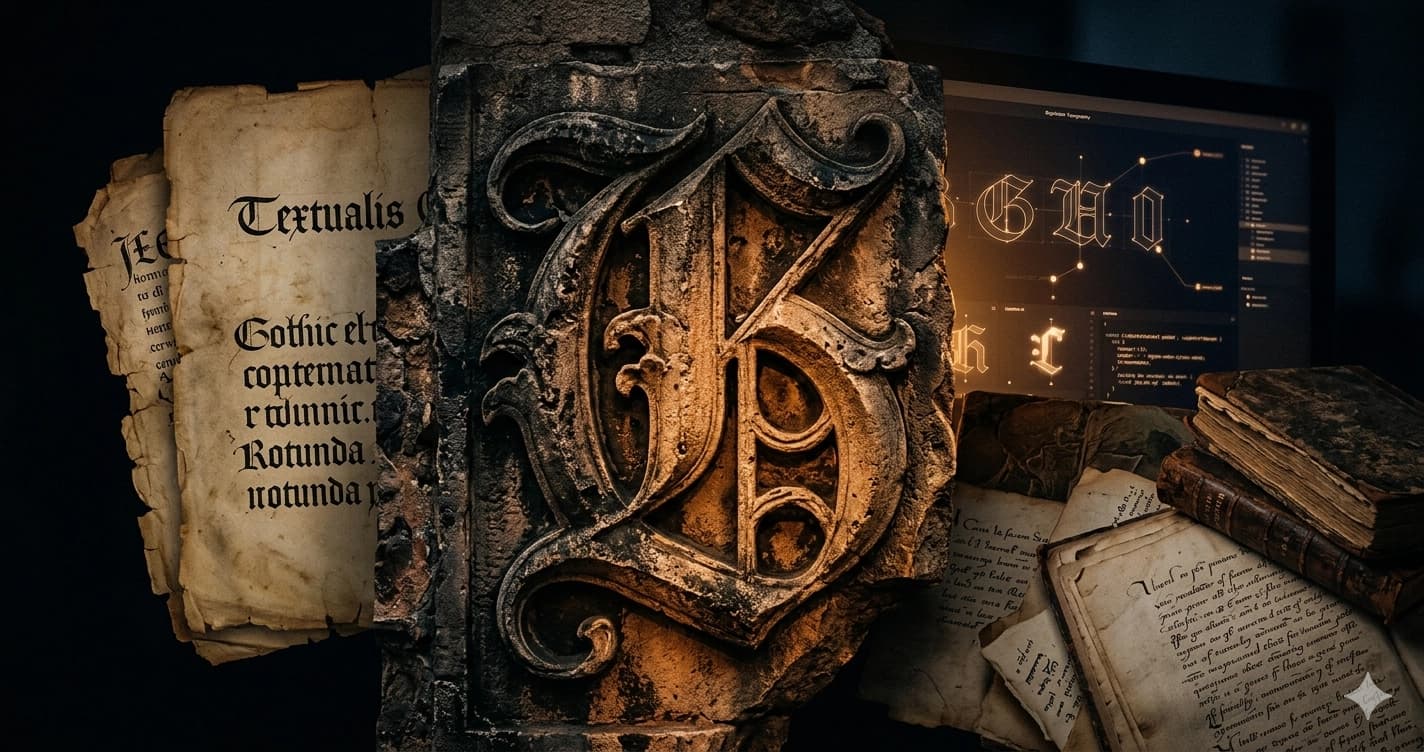
Gothic Fonts — History, Culture, and Why They're Everywhere Online
Gothic lettering is everywhere — Discord usernames, streetwear logos, tattoo studios, band merchandise. But where does it come from, and why has it never gone out of style?
What Is Gothic Script?
Gothic script — also called Blackletter or Old English — is a family of medieval European writing styles developed in Western Europe from the 12th century onward. It replaced earlier Carolingian minuscule as manuscripts became more dense and books more compact.
The defining features of gothic script are the angular, broken strokes that give letters their dark, textured appearance — a stark contrast to the rounded forms of earlier scripts. The style prioritized density and decorative complexity over readability. A page of gothic text has a visual weight that no modern typeface fully replicates: it reads as serious, ancient, and authoritative simultaneously.
There are four main subfamilies of gothic script, each with its own visual character:
Textura — the most rigorous and geometric form. Letters are reduced to near-vertical strokes with diamond-shaped serifs. Used for formal religious manuscripts. Gutenberg's Bible was set in Textura.
Rotunda — a rounder, more open form developed in Southern Europe (Italy, Spain). Less angular than northern blackletter, bridging Gothic and later humanist scripts.
Bastarda / Cursiva — a looser, more cursive variant for everyday writing. Less formal than Textura, faster to write, with more variation between scribes.
Fraktur — developed in 16th-century Germany, it became the dominant German typeface for four centuries. The characteristic broken strokes and decorative capitals of Fraktur are what most people picture when they think of "gothic" type today.
A Brief History
12th–15th century — Gothic script becomes the dominant writing style across Western Europe. Used for religious manuscripts, legal documents, and early printed books. The style develops regional variations but shares a common angular aesthetic that makes pages dense and visually imposing.
1450s — Gutenberg's printing press uses gothic type (Textura) for his famous Bible. Gothic is the default typeface of early European printing — not because it looked old-fashioned, but because it was the most current, prestigious script of the day.
16th century — Italy develops humanist scripts modeled on classical Roman letterforms — the ancestors of modern Roman and Italic fonts. The rest of Europe gradually adopts them. Germany and Northern Europe hold on to Fraktur, which becomes increasingly associated with German national identity.
17th–18th century — The rest of Europe has largely moved to Roman type. Germany uses Fraktur for almost all printing — newspapers, books, official documents. The divide between "German" (Fraktur) and "Roman" type becomes a cultural and political issue.
19th century — Gothic typefaces are revived across Europe and America by the Arts and Crafts movement as a symbol of medieval craftsmanship, pre-industrial authenticity, and nationalist identity. Newspapers adopt gothic masthead lettering (a tradition that persists today — The New York Times masthead is still set in Old English).
1941 — The Nazi regime, which had promoted Fraktur as the authentic "German" typeface, abruptly bans it. They claimed, incorrectly, that Fraktur was actually a "Jewish" invention. The true reason was practical: as Germany occupied more of Europe, Fraktur was unreadable to non-German populations. Roman type was easier to use across occupied territories.
20th century (post-war) — Gothic type appears in heavy metal album art, punk zines, and tattoo culture. Its associations with darkness, tradition, rebellion, and counterculture make it a natural fit for aesthetics that want to signal edge and seriousness.
Today — Gothic Unicode characters bring the style to social media, Discord, and anywhere plain text is used. The same cultural weight that made gothic type the choice of medieval monks, 19th-century nationalists, and heavy metal bands now makes it the choice of Discord usernames and Instagram bios.
The Nazi Paradox
One of the most surprising facts about gothic type is the story of its relationship with 20th-century German nationalism. Fraktur was widely used as a symbol of German identity and was enthusiastically promoted by the Nazi regime in the 1930s. It appeared on propaganda posters, official documents, and party materials.
Then, in January 1941, Hitler issued a directive banning Fraktur — labeling it "Schwabacher Judenlettern" (Swabian Jewish letters) and ordering a switch to Roman type for all future printing.
The reversal was entirely cynical. The Nazis hadn't discovered that Fraktur was "Jewish" — it wasn't. They needed a typeface that German-occupied populations across Europe could read. Fraktur was illegible to most non-German Europeans, making it useless for propaganda in occupied France, Poland, and elsewhere.
The irony is complete: the typeface promoted as the authentic expression of German identity was abandoned because it was inconvenient. It's a reminder that the cultural meanings attached to typefaces are always constructed, never inherent.
Why Gothic Fonts Dominate Online Culture
The appeal of gothic lettering online is rooted in the same cultural associations it's carried for centuries: authority, darkness, tradition, and rebellion.
These associations work in every direction simultaneously, which is why gothic type is so versatile:
Authority — gothic type appears on diplomas, newspaper mastheads, legal documents, and religious texts. Using it borrows that institutional weight. A streetwear brand with a gothic logo is implicitly claiming the visual language of centuries-old institutions.
Darkness and edge — heavy metal, punk, and goth subcultures claimed gothic type as their own visual language from the 1970s onward. Those associations now extend into gaming, dark aesthetics, and alternative communities online.
Tradition and craft — gothic type signals hand-made, pre-industrial authenticity. Tattoo culture adopted it for this reason. A gothic tattoo reads as timeless rather than trendy.
Rebellion — precisely because gothic type carries these establishment associations, using it ironically or in unexpected contexts is an act of aesthetic subversion. Streetwear has been doing this for decades.
On Discord, a gothic username signals seriousness and aesthetic commitment. On Instagram, gothic text in a bio declares identity — it's a visual shorthand for specific subcultures and aesthetics that readers recognize immediately. On streetwear brands, it borrows the visual language of institutional authority and recontextualizes it as cool.
Gothic Type in Specific Online Communities
Gaming and esports — gothic usernames are common in RPG, dark fantasy, and strategy gaming communities. The aesthetic matches games like Dark Souls, Elden Ring, and Diablo. A guild or clan name in gothic text communicates seriousness and lore investment.
Music — metal, black metal, gothic rock, and doom metal have used blackletter for album art and band logos for fifty years. The tradition carries forward into online music communities. An artist's Instagram name in gothic signals genre affiliation before anyone hears a note. For the full history of heavy metal typography — who designed the iconic logos and why death metal logos are illegible by design — see Heavy Metal Fonts.
Streetwear — brands from Supreme to Palace to countless independent labels use gothic type for logos, capsule collections, and product names. The visual language connects to Chicano lettering traditions (themselves derived from Old English script) and the broader heritage of American tattoo culture.
Tattoo — gothic text is one of the most requested tattoo styles globally. Name tattoos, memorial tattoos, and lettering pieces in Fraktur or Old English are perennial staples of traditional and neo-traditional tattooing. The weight and permanence of gothic letterforms matches the permanence of the medium. For a detailed guide on blackletter subfamilies, Chicano roots, and what actually ages well on skin, see Gothic Fonts for Tattoos.
Dark aesthetic / alternative communities — Tumblr, Instagram, and TikTok communities around dark aesthetics, cottagecore-adjacent dark variants, and alternative fashion consistently use gothic type as part of their visual identity.
Spiritual and mystic aesthetics — witchcore, dark academia, tarot, and occult-adjacent communities have adopted Gothic as their primary typographic signal. The association with medieval manuscripts, grimoires, and esoteric traditions makes it the natural choice for creators in these niches. For a full breakdown of which Unicode style fits which spiritual aesthetic — witchcore vs. boho vs. astrology vs. cottagecore — see Mystic & Spiritual Fonts — Unicode Guide.
Gothic vs. Old English vs. Fraktur — What's the Difference?
These terms are often used interchangeably online, but they describe related but distinct things:
| Term | Meaning |
|---|---|
| Gothic | Broad term for all medieval European blackletter scripts |
| Old English | Specifically the Textura variant as used in England; also used loosely to mean any blackletter |
| Fraktur | German blackletter developed in the 16th century; the most recognizable modern form |
| Blackletter | Technical umbrella term for all gothic scripts |
In casual use online, "gothic font" and "old english font" refer to the same visual style — the dark, angular letterforms of the Fraktur or Textura tradition. The Unicode mathematical Fraktur characters are what most font generators use, so the technical name is Fraktur even when marketed as "gothic" or "old english."
Gothic Unicode Characters
The Unicode gothic characters used by Lettertype come from the Mathematical Fraktur blocks:
- Mathematical Fraktur Lowercase: 𝔞 𝔟 𝔠 𝔡 𝔢 𝔣 𝔤 𝔥 𝔦 𝔧 𝔨 𝔩 𝔪 𝔫 𝔬 𝔭 𝔮 𝔯 𝔰 𝔱 𝔲 𝔳 𝔴 𝔵 𝔶 𝔷
- Mathematical Fraktur Uppercase: 𝔄 𝔅 ℭ 𝔇 𝔈 𝔉 𝔊 ℌ ℑ 𝔍 𝔎 𝔏 𝔐 𝔑 𝔒 𝔓 𝔔 ℜ 𝔖 𝔗 𝔘 𝔙 𝔚 𝔛 𝔜 ℨ
These characters were included in Unicode for mathematical use — Fraktur variables appear in physics and set theory notation (𝔤 for Lie algebras, ℌ for Hilbert spaces, ℑ for the imaginary part of a complex number). They're used decoratively online because they happen to look like gothic type, not because that was Unicode's intention.
This is why gothic Unicode text works universally: it's not a font file, it's actual characters defined in the Unicode standard. When you paste 𝔊𝔬𝔱𝔥𝔦𝔠 into a Discord username or Instagram bio, every viewer sees those exact characters regardless of what fonts they have installed.
How to Use Gothic Text Effectively
In usernames and display names — gothic text works best for single words or short phrases. A full sentence in gothic script is harder to read; a username like 𝔇𝔞𝔯𝔨𝔏𝔬𝔯𝔡 or 𝔖𝔥𝔞𝔡𝔬𝔴𝔚𝔬𝔩𝔣 is immediately recognizable and readable.
In bios — use gothic for one line maximum (your name or tagline), then switch to plain text for the rest. The contrast makes the gothic text pop and keeps the bio readable.
In captions and tweets — gothic text works for emphasis or section headers in long captions, but full paragraphs in gothic are hard to read at pace. Use it for your opening hook or a key phrase.
Pairing with other styles — gothic text pairs well with plain text and small caps. It clashes with bubble text, vaporwave, and most other decorative styles. The visual weight of gothic needs contrast from something lighter, not competition from something equally decorative.
Dark mode consideration — gothic text is highly legible on dark backgrounds (Discord's default dark mode, dark-themed Instagram), which is one reason it's so popular on Discord specifically.
Gothic Fonts in Streetwear
The gothic aesthetic in streetwear traces directly to early 2000s LA streetwear brands that borrowed from Chicano lettering traditions, which themselves drew on Old English script. Brands like Supreme have used gothic letterforms for decades — their box logo uses Futura, but their lettering pieces and collaborations frequently reach for blackletter.
The connection between gothic script and institutional authority — diplomas, newspaper mastheads, religious texts — gives streetwear brands using it a sense of heritage and legitimacy. It's a visual trick that works precisely because gothic type carries so much cultural weight.
This is also why gothic type works in fine dining, luxury goods, and high fashion contexts as well as in streetwear and metal — it's authoritative in all directions, which gives designers enormous flexibility in how they deploy it.
Generate Gothic Text
Try gothic Unicode text at Lettertype's Gothic Generator — generates gothic text instantly for Instagram, Discord, Twitter, TikTok, and anywhere that accepts Unicode. Browse the full alphabet letter-by-letter, copy individual characters, or download styled letters as images for creative projects.
Example names in gothic:
- 𝔇𝔞𝔯𝔨𝔏𝔬𝔯𝔡 · 𝔖𝔥𝔞𝔡𝔬𝔴𝔚𝔬𝔩𝔣 · 𝔄𝔯𝔠𝔞𝔫𝔢𝔚𝔦𝔷𝔞𝔯𝔡
- 𝔐𝔲𝔰𝔦𝔠 𝔦𝔰 𝔱𝔥𝔢 𝔬𝔫𝔩𝔶 𝔱𝔯𝔲𝔱𝔥
- 𝔗𝔥𝔢 𝔇𝔞𝔯𝔨 𝔏𝔬𝔲𝔫𝔤𝔢