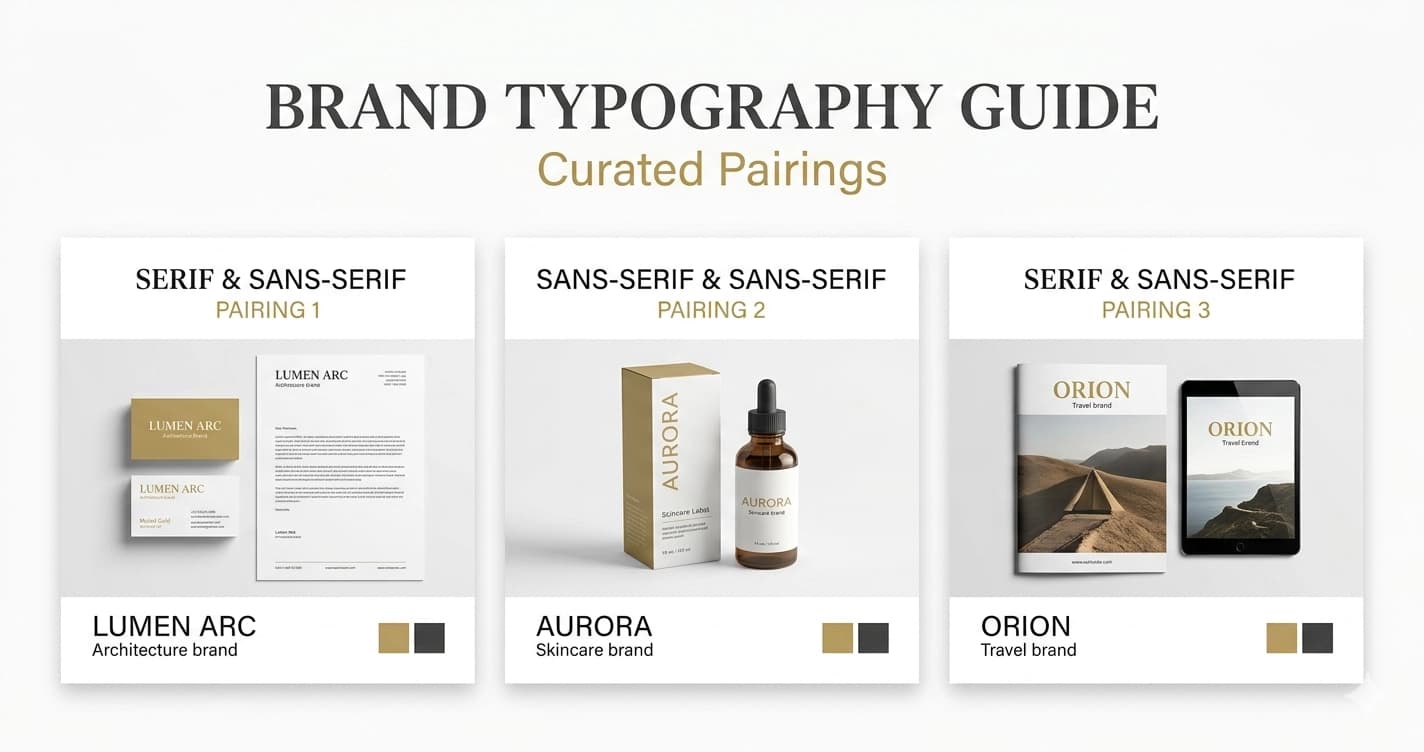
Brand Typography for Creators — How Font Choice Builds (or Breaks) Your Identity
Your audience makes a visual judgment about your brand in the first 90 milliseconds of seeing it. That judgment is based almost entirely on visual signals — color, layout, imagery, and typography. Of these, typography is the one most consistently underestimated by creators and small business owners who don't come from design backgrounds.
This guide covers the essentials: what your font choices communicate, how to build a coherent typographic system, and how Unicode styled fonts fit (and don't fit) into a creator brand.
What Fonts Communicate Before Anyone Reads a Word
Typography communicates personality traits before content is processed. Research on visual perception shows that font choices trigger associations in under 100 milliseconds — faster than language processing.
These associations are not arbitrary. They're the product of centuries of typographic history and decades of brand conditioning:
| Font Category | Psychological Associations | Industries That Use It |
|---|---|---|
| Classic Serif (Georgia, Garamond) | Authority, tradition, trustworthiness, heritage | Legal, finance, luxury, publishing |
| Modern Serif (Bodoni, Didot) | Fashion, sophistication, editorial elegance | Luxury fashion, high-end magazines |
| Humanist Sans-Serif (Gill Sans, Optima) | Friendly, accessible, approachable | Healthcare, education, consumer brands |
| Geometric Sans-Serif (Futura, Helvetica) | Modern, clean, precise, efficient | Technology, architecture, Swiss design |
| Slab Serif (Rockwell, Clarendon) | Dependable, bold, strong, industrial | Sports, outdoors, food and beverage |
| Script / Cursive | Creative, personal, feminine, handcrafted | Beauty, lifestyle, wedding, artisan food |
| Gothic / Blackletter | Heritage, authority, counterculture, tradition | Streetwear, metal, tattoo culture, newspapers |
| Monospace | Technical, precise, developer-world | Technology, software, typewriter aesthetic |
| Display / Decorative | Unique, attention-seeking, expressive | Entertainment, events, editorial |
The brand alignment test: Does the psychological association of your chosen font match what you want your audience to feel about you? A wellness coach using aggressive Gothic type creates cognitive dissonance. A luxury brand using playful Comic Sans undermines their positioning. Alignment between font personality and brand personality builds trust; misalignment creates friction.
The Fortune 500 Data Point
Looking at how successful companies use typography provides useful evidence about what works at scale:
- ~70% of Fortune 500 companies use sans-serif in their primary logo/wordmark
- ~30% use serif
- Of those using serif: the majority are in finance, publishing, legal, or luxury sectors
- Of those using sans-serif: the majority are in technology, consumer goods, and services
This doesn't mean sans-serif is "better" — it means sans-serif signals the qualities (modernity, approachability, innovation) that most large consumer-facing companies want to communicate.
For creators, the pattern holds at smaller scale: the font that fits your niche is right for you, regardless of what fits the Fortune 500.
The 2–3 Typeface Rule
The single most important practical rule in brand typography: use no more than 2–3 typefaces in your visual identity.
This is not an aesthetic preference. It's a cognitive load principle. Each typeface in a design system requires the viewer to process a distinct visual personality. More than 2–3 personalities create confusion rather than richness.
The classic two-typeface system:
Primary typeface — Your main brand font. Used for your name, headlines, and any text that carries your brand identity. Should be distinctive and characteristic.
Secondary typeface — Your supporting font. Used for body text, captions, and supporting content. Should provide contrast to the primary without competing with it. Often a clean, highly readable sans-serif paired with a more distinctive primary.
The optional third typeface — An accent font. Used sparingly for specific purposes: pull quotes, decorative elements, calls to action. Using it too widely defeats its purpose.
Common pairings:
- Serif headline + Sans-serif body (the editorial standard)
- Script display + Geometric sans body (lifestyle/beauty brand standard)
- Bold geometric sans headline + Light geometric sans body (tech brand standard)
- Gothic display + Clean serif body (dark aesthetic or heritage brand)
Building a Typography System for Creators
Step 1: Define Your Brand Personality
Before choosing fonts, articulate 3–5 adjectives that describe your brand:
- Warm and approachable? → Script or humanist sans
- Authoritative and expert? → Serif or bold sans
- Edgy and countercultural? → Gothic or display
- Clean and modern? → Geometric sans
- Artistic and creative? → Something more expressive
Your font choices should visually represent these adjectives.
Step 2: Choose Your Primary Typeface
This is the most consequential choice. It will appear in your name, your thumbnails, your social profiles, and any branded content. It needs to:
- Be readable at multiple sizes (from 10px on mobile to large on YouTube thumbnails)
- Be distinctive enough to be recognizable over time
- Accurately represent your brand personality
- Be accessible (you can license it for all commercial uses)
Step 3: Choose Your Secondary Typeface
Your secondary typeface needs to provide contrast to your primary without competing. Classic rules:
- Personality contrast: One serious + one expressive. One historical + one modern. One heavy + one light.
- Structure contrast: If your primary is a serif, make your secondary a sans-serif, and vice versa.
- Weight contrast: If your primary is bold and heavy, your secondary should be lighter and more neutral.
Avoid: Two serifs that are similar (creates confusion, not harmony). Two display fonts (neither can do its job). Two fonts with similar moods (reduces the visual hierarchy they create together).
Step 4: Establish Usage Rules
Document which typeface goes where:
- Primary: Logo, name, H1 headlines
- Secondary: Body text, captions, descriptions
- Accent (if used): Pull quotes, callouts, decorative elements
Consistency in usage is more important than any individual font choice. A consistent, predictable system builds recognition; an inconsistent system erodes it.
Cross-Platform Consistency
Creator brands operate across multiple platforms simultaneously — YouTube, TikTok, Instagram, Discord, Twitter. Each platform has its own font conventions and technical constraints. Maintaining typographic consistency across them is essential for recognition.
What You Can Control per Platform
| Platform | What You Can Control |
|---|---|
| YouTube | Thumbnail typography (full control), channel art, banner |
| Display name (Unicode), bio (Unicode), post text overlay | |
| TikTok | Display name (Unicode), bio (Unicode), video text overlay |
| Discord | Display name (Unicode), bio, server name, role names |
| Twitter / X | Display name (Unicode, 50 chars), bio, image overlays |
| Website | Full control — this is where your full type system lives |
| Header images, some email clients support custom fonts |
The Unicode Solution for Social Profiles
For social media display names and bios — where you can't install fonts — Unicode styled text provides a way to maintain typographic identity across platforms.
If your brand uses a script/cursive primary typeface, using Bold Cursive Unicode text in your display name and bio creates a visual connection to your overall brand identity without requiring any font file.
If your brand is dark and Gothic, using Gothic/Fraktur Unicode in display names creates cross-platform consistency.
The limitation: Unicode styled text is an approximation of your actual brand typeface, not a replacement. It works best for social profiles; your website, printed materials, and video production should use your actual licensed typefaces.
Typography in Video Content
For creators producing video (YouTube, TikTok, Reels), typography appears in:
- Thumbnails — the highest-impact typography decision. Thumbnail text must be readable at small sizes in the YouTube browse view. Bold, high-contrast, large type performs better than elegant, delicate type.
- Lower thirds / name cards — identification graphics in-video
- Title cards — opening or section title slides
- Captions — closed caption styling (if custom)
Thumbnails especially benefit from consistent typeface use. Viewers recognize a creator's content in the browse grid partly through visual patterns — color, composition, and typography. Consistent thumbnail typography builds that recognition over time.
When Unicode Fonts Work for Branding
Good Uses
Social media display names and bios — Unicode styled text in display names creates visual distinctiveness without any design software. A Bold Cursive display name on Instagram, TikTok, and Discord creates cross-platform consistency for lifestyle and creative brands.
Email signatures — Unicode styled text renders in most email clients. A styled name in your signature adds personality without requiring the recipient to have any font installed.
Discord server branding — Server names, role names, and channel headers in Unicode styled text create a cohesive server aesthetic. Gothic role names (𝔐𝔬𝔡𝔢𝔯𝔞𝔱𝔬𝔯, 𝔙𝔦𝔭) signal a dark aesthetic server identity consistently.
Social captions — Styled text in caption hooks or emphasis points creates visual variety in an otherwise plain-text medium.
Poor Uses
Logo or wordmark — Your actual logo needs a vector file (SVG, AI, EPS) in a properly licensed typeface. Unicode text is not a substitute for brand identity design.
Print materials — Business cards, flyers, packaging. These require proper font files. Unicode text copied into a design program may not render correctly or may be missing ligatures and professional features.
Large-scale display — Digital signage, event graphics, large banner printing. Unicode characters from Mathematical Alphanumeric blocks may not be available in all font families installed on display systems.
Any context requiring consistency with your licensed typeface — If your brand uses a specific typeface (say, Canela or Freight Display), Unicode Bold Cursive is not a replacement. Use the actual typeface.
Typography Resources for Creators
Free Font Sources
- Google Fonts (fonts.google.com) — 1,400+ free fonts licensed for commercial use; integrates directly with websites and design software
- Adobe Fonts (included with Creative Cloud) — thousands of quality fonts for Adobe CC subscribers
- DaFont (dafont.com) — large collection; check individual license terms before commercial use
- Font Squirrel (fontsquirrel.com) — curated free-for-commercial-use fonts
Font Pairing Tools
- Fontpair.co — curated Google Fonts pairings with visual previews
- Typ.io — real-world font pairing examples from live websites
- Google Fonts — has a built-in pairing suggestions feature
When to Hire a Designer
For creator brands reaching the point of consistent monetization (course sales, merchandise, sponsorships), investing in a professional brand identity design — including a considered typography system — typically pays for itself in perceived professionalism.
A basic brand identity design from a professional designer ranges from $500–$2,000 for a creator-scale brand (logo, color palette, typography system, usage guidelines). This is the point at which your typography system stops being something you figure out yourself and becomes a documented asset of your business.
Generate Unicode Typography for Your Profiles
Every Unicode styled font style for social media display names, bios, and captions is available at Lettertype:
- Bold Cursive — lifestyle, beauty, creative brands
- Gothic — dark aesthetic, music, streetwear, heritage
- Small Caps — minimalist, professional, subtle distinction
- Italic — elegant, editorial, refined
- Vaporwave — retro, digital aesthetic, Y2K-adjacent
- Monospace — tech, developer, typewriter aesthetic
Generate, copy, and paste into any platform's display name or bio field.