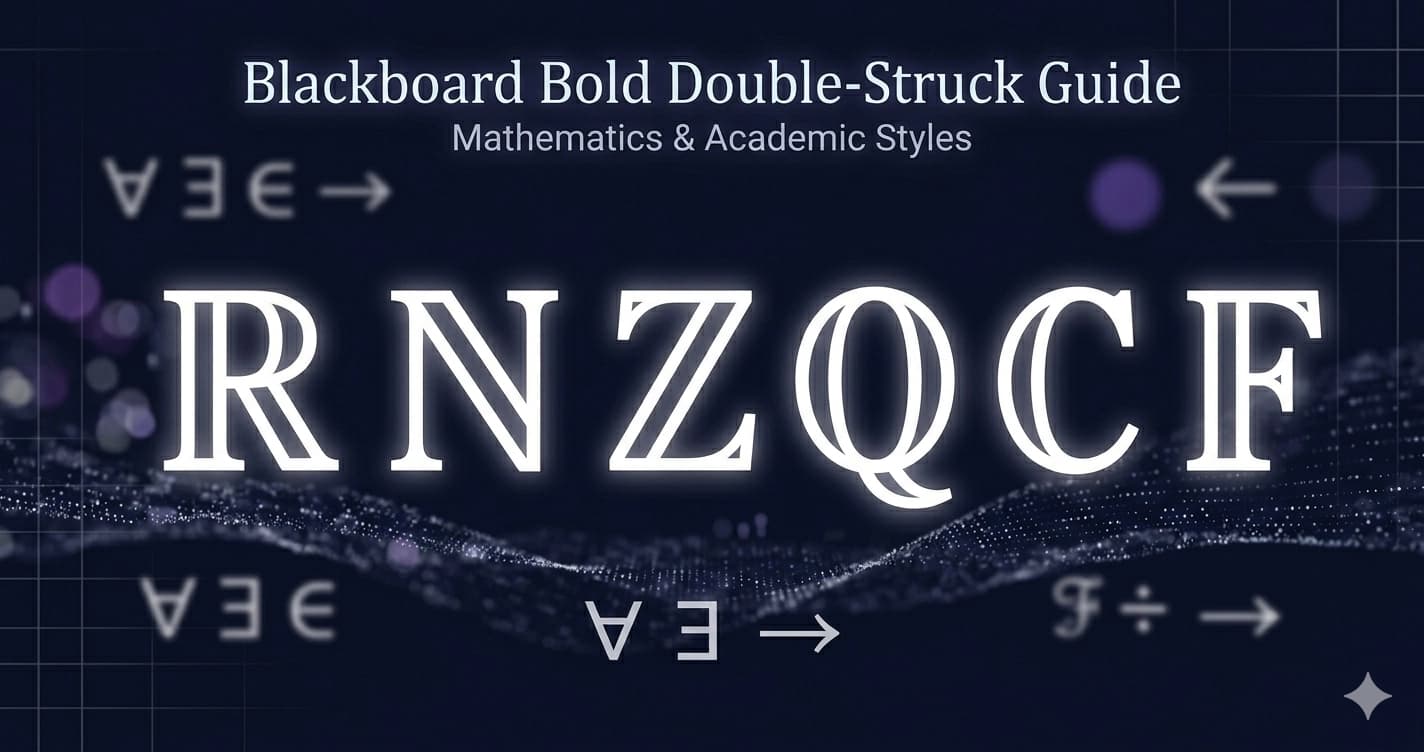
Double-Struck Fonts — The Mathematical Origins of Blackboard Bold Unicode
The characters 𝔻, 𝕆, 𝕌, 𝔹, 𝕃, 𝔼 don't come from a font file. They come from Unicode's Mathematical Alphanumeric Symbols block — a section of the Unicode standard that exists because mathematicians in the 1960s needed a way to write certain letters on blackboards that couldn't be confused with other letters.
This is the story of how a practical notation problem in academic mathematics became one of the most aesthetically distinctive Unicode text styles available for copy-paste use today.
What Double-Struck Means
"Double-struck" refers to the visual technique of striking a letter twice with a pen or chalk — once normally, then again slightly offset — to create a stroke that appears doubled or outlined. Applied to a typeface, it produces letters with a distinctive parallel-stroke structure: look at the vertical stroke of a double-struck capital N (𝕹) and you'll see two parallel lines where a regular N has one.
In formal typography, this style is called blackboard bold — because it originated on university blackboards, where professors needed to write bold letters but couldn't achieve the density of print-bold with chalk.
The Unicode name for these characters is Mathematical Double-Struck.
The Blackboard Origin: Princeton, 1960s
The conventional account of blackboard bold traces to the 1960s mathematics departments of elite universities — Princeton and the Institute for Advanced Study are most frequently cited.
The practical problem: in formal mathematics, the same letter can represent multiple different things. An uppercase A in italic might denote a matrix. The same A in bold might denote a different kind of object. The same A in Roman (upright) might denote something else entirely. In print, these distinctions are handled by the typesetter. On a blackboard, they can't be.
Professors writing on blackboards began developing a convention: to write "bold" letters, they would draw the main vertical strokes of a letter twice, with a small gap between the strokes, creating the visual impression of a bold letter with the practical materials of chalk. The technique caught on because it was simple, reproducible by students, and visually distinct.
By the late 1960s, certain specific letters had acquired standard meanings in this style:
| Symbol | Domain | Meaning |
|---|---|---|
| ℕ | Natural numbers | {1, 2, 3, 4, ...} or {0, 1, 2, 3, ...} |
| ℤ | Integers | {..., -2, -1, 0, 1, 2, ...} |
| ℚ | Rational numbers | All fractions p/q where p, q ∈ ℤ |
| ℝ | Real numbers | All points on the number line |
| ℂ | Complex numbers | All numbers of the form a + bi |
| ℙ | Prime numbers (or projective space) | Context-dependent |
| ℍ | Quaternions | The skew field H discovered by Hamilton |
These became — and remain — the standard notation for these fundamental mathematical sets across academic disciplines worldwide.
From Blackboard to Unicode
The transition from academic convention to Unicode character set happened in stages.
LaTeX and TeX: Before Unicode, the mathematical typesetting system TeX (created by Donald Knuth, 1978) and its extension LaTeX provided a \mathbb{} command for blackboard bold characters. This formalized the style as a typographic standard in academic publishing. If you've ever read a mathematics or physics paper and seen the distinctive double-stroked capital R or Z, it was almost certainly rendered through TeX's blackboard bold implementation.
Unicode inclusion: The Unicode Consortium included double-struck mathematical characters in Unicode 3.1 (2001), primarily in the Mathematical Alphanumeric Symbols block (U+1D400–U+1D7FF). This block contains 996 code points covering mathematical versions of Latin and Greek letters and digits in multiple styles: Bold, Italic, Bold Italic, Script, Bold Script, Fraktur, Double-Struck, and others.
The most commonly used double-struck characters — ℕ, ℤ, ℚ, ℝ, ℂ, ℍ — were encoded separately in the Letterlike Symbols block (U+2100–U+214F) because they had already established meaning as standalone characters before the full Mathematical Alphanumeric block was created.
The Complete Double-Struck Alphabet
Uppercase: 𝔸 𝔹 ℂ 𝔻 𝔼 𝔽 𝔾 ℍ 𝕀 𝕁 𝕂 𝕃 𝕄 ℕ 𝕆 ℙ ℚ ℝ 𝕊 𝕋 𝕌 𝕍 𝕎 𝕏 𝕐 ℤ
Lowercase: 𝕒 𝕓 𝕔 𝕕 𝕖 𝕗 𝕘 𝕙 𝕚 𝕛 𝕜 𝕝 𝕞 𝕟 𝕠 𝕡 𝕢 𝕣 𝕤 𝕥 𝕦 𝕧 𝕨 𝕩 𝕪 𝕫
Digits: 𝟘 𝟙 𝟚 𝟛 𝟜 𝟝 𝟞 𝟟 𝟠 𝟡
Note: C, H, N, P, Q, R, and Z in uppercase use characters from Letterlike Symbols (ℂ, ℍ, ℕ, ℙ, ℚ, ℝ, ℤ) rather than Mathematical Double-Struck, for historical reasons. They render identically in most fonts.
Where Double-Struck Works Today
Academic and Scientific Contexts
Double-struck notation is still the standard in mathematics, physics, theoretical computer science, and related fields. Any paper discussing number theory, functional analysis, topology, or abstract algebra will use ℕ, ℤ, ℚ, ℝ, and ℂ routinely.
GitHub and academic repositories: Double-struck characters render correctly in GitHub README files, LaTeX embedded in Markdown (with appropriate extensions), and in issues and comments. Developers working on mathematical libraries often use ℝ and ℤ directly in comments and documentation.
Reddit and Discord STEM communities: Unicode double-struck characters work directly in Reddit posts and comments, and in Discord messages. STEM-focused Discord servers often use them for mathematical notation in informal discussion.
Aesthetic Use
Outside academia, double-struck characters have developed a distinct aesthetic appeal. The parallel-stroke structure gives letters a visual complexity that's different from every other Unicode style — not as dark as Gothic, not as flowing as Bold Cursive, but visually rich and immediately recognizable.
The dark academia aesthetic — literary, scholarly, slightly melancholy — has adopted double-struck text as one of its signature styles on Instagram and TikTok. A bio or caption using 𝕕𝕒𝕣𝕜 𝕒𝕔𝕒𝕕𝕖𝕞𝕚𝕒 signals both visual sophistication and the intellectual associations of the aesthetic.
Double-Struck vs. Other Mathematical Unicode Styles
The Mathematical Alphanumeric block includes multiple styles, each with distinct visual character and associations:
| Style | Example | Visual Character | Common Use |
|---|---|---|---|
| Double-Struck | 𝔻𝕠𝕦𝕓𝕝𝕖 | Parallel strokes, structured | Math notation, dark academia |
| Mathematical Bold | 𝐁𝐨𝐥𝐝 | Heavier version of Roman | Emphasis in math text |
| Mathematical Italic | 𝐼𝑡𝑎𝑙𝑖𝑐 | Slanted, elegant | Variables in equations |
| Mathematical Script | 𝒮𝒸𝓇𝒾𝓅𝓉 | Flowing, cursive | Operators, function spaces |
| Mathematical Fraktur | 𝔉𝔯𝔞𝔨𝔱𝔲𝔯 | Gothic, angular | Lie algebras, some physics notation |
| Mathematical Monospace | 𝙼𝚘𝚗𝚘 | Fixed-width | Code in math papers |
Each of these styles was included in Unicode specifically for mathematical use, where the same letter in different styles denotes different mathematical objects. Their aesthetic use as copy-paste fonts is a secondary application that emerged from their availability in the Unicode standard.
Platform Rendering and Compatibility
Double-struck characters are part of the Mathematical Alphanumeric Symbols block, which requires font support for the Supplementary Multilingual Plane (Unicode code points above U+FFFF). Modern operating systems and devices handle this well, but there are edge cases.
| Platform | Rendering | Notes |
|---|---|---|
| iOS (2015+) | Excellent | Built-in Unicode font support |
| Android (2015+) | Excellent | Noto fonts provide full coverage |
| Windows 10/11 | Excellent | Segoe UI Symbol covers most blocks |
| macOS (2015+) | Excellent | Apple Color Emoji and system fonts cover the block |
| Renders correctly | Display name, bio, captions | |
| TikTok | Renders correctly | Display name, bio |
| Discord | Renders correctly | Display name, bio, messages |
| Twitter / X | Renders correctly | Display name, tweets |
| Older Android (pre-2015) | Partial | Some devices show boxes |
The practical conclusion: double-struck Unicode text renders correctly for essentially all current users on modern platforms. The edge cases (very old devices) are a small and declining fraction.
The Aesthetic Appeal of Double-Struck
The visual logic of double-struck text is different from other styled Unicode fonts. Most styles derive their appeal from cultural associations: Gothic from medieval history and metal culture, Bold Cursive from calligraphic tradition, Vaporwave from 1980s digital nostalgia.
Double-struck derives its appeal from visible structure. The parallel strokes show their own construction — you can see how the letterform is built. This gives the style a quality of deliberate craft that purely decorative fonts lack. It reads as intentional in a specific way: not just "styled," but "constructed."
This quality makes double-struck particularly suitable for contexts where you want to signal intelligence, academic sensibility, or careful attention without the heaviness of Gothic or the romanticism of cursive. Dark academia accounts use it for exactly this reason — it communicates the aesthetic's scholarly associations through typographic structure.
Why ℝ Is Not the Same as R
A note on why these characters exist at all in Unicode, rather than just being rendered by fonts: in mathematics, the same letter in a different style is a different symbol with a different meaning.
In a typical equation in functional analysis:
- R (Roman bold) might denote a linear operator
- R (italic) might denote a real variable
- ℝ (double-struck) denotes the set of all real numbers
These are not the same. A reader who confuses them misreads the mathematics. Unicode's Mathematical Alphanumeric Symbols block exists precisely to make these distinctions unambiguous in digital text — so that a mathematician writing an equation in a chat message, a GitHub issue, or a Discord server can convey the correct meaning without ambiguity.
The aesthetic copy-paste use of these characters is, in a sense, borrowing the precision of mathematical notation for expressive purposes. The characters were designed to be unambiguous. Their visual distinctiveness — the property that makes them work for mathematics — is also what makes them visually interesting as aesthetic text.
Generate Double-Struck Text
Type any text in Lettertype's Double-Struck Generator and copy-paste the result into any platform that supports Unicode — Discord bios and display names, Instagram bios and captions, TikTok, Twitter, and beyond.
The full Mathematical Alphanumeric Symbols block — including Bold, Italic, Script, Fraktur, and Monospace variants — is available through Lettertype's full generator.