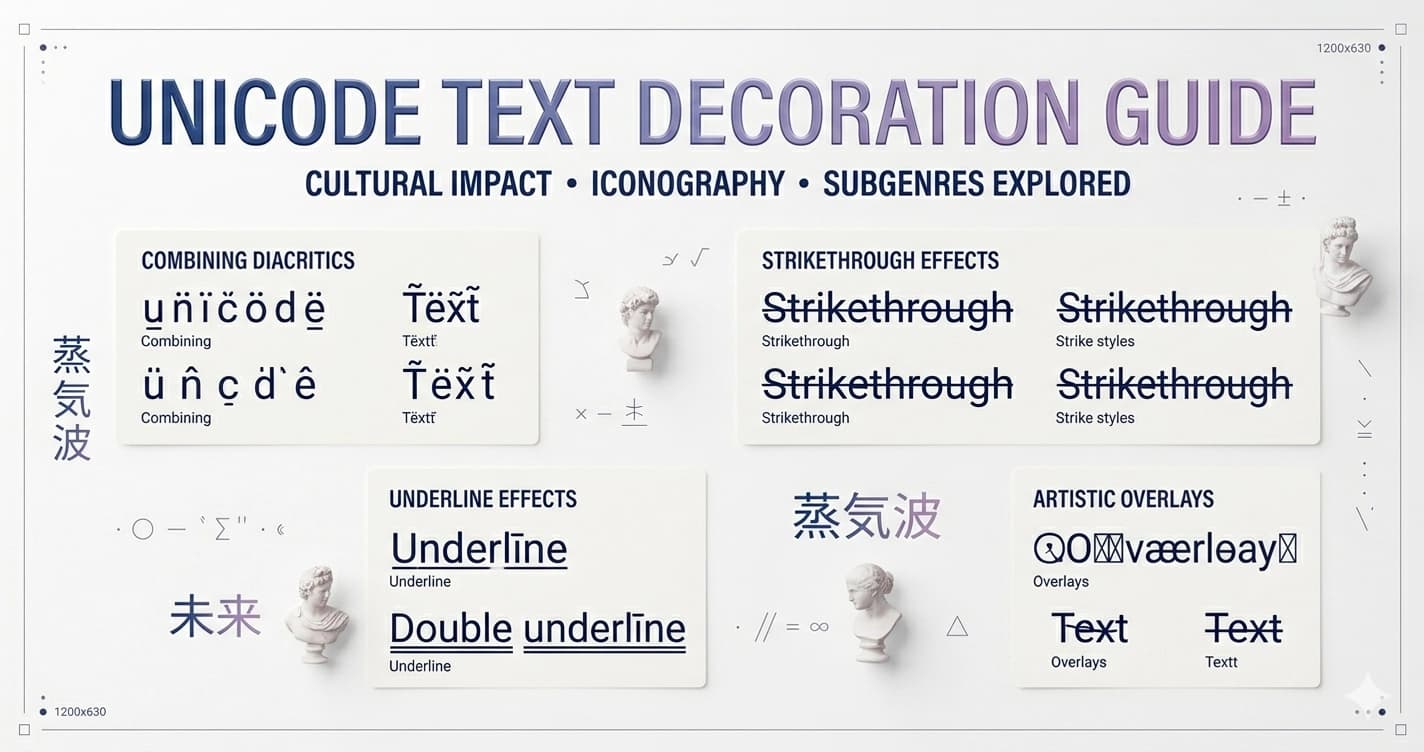
Unicode Text Decoration — Strikethrough, Underline, and Overlay Effects Without HTML
In most text environments, adding strikethrough or underline to text requires formatting: <del> in HTML, ~~text~~ in Discord Markdown, or a formatting button in a word processor. The formatting is applied as metadata separate from the text itself — it travels with the document format but gets stripped when the text is copied as plain text.
Unicode text decoration is different. It works at the character level, using combining diacritical marks that attach to base characters and produce visual effects that survive copy-paste, work in plain-text fields, and render on any Unicode-capable platform — including Instagram bios, TikTok display names, Discord status messages, and anywhere else that accepts text.
How Unicode Combining Characters Create Decoration
Unicode combining characters (primarily from the Combining Diacritical Marks block, U+0300–U+036F) are zero-width characters that attach to the preceding base character rather than occupying their own space.
Most combining characters are accent marks: U+0301 (COMBINING ACUTE ACCENT) produces á when attached to 'a'. But several combining characters in this block are designed not for language-specific accents but for text decoration — specifically, characters that draw lines through or under base characters:
| Code Point | Name | Effect | Example |
|---|---|---|---|
| U+0336 | COMBINING LONG STROKE OVERLAY | Strikethrough | t̶e̶x̶t̶ |
| U+0332 | COMBINING LOW LINE | Underline | t̲e̲x̲t̲ |
| U+0338 | COMBINING LONG SOLIDUS OVERLAY | Slash-through | t̸e̸x̸t̸ |
| U+0334 | COMBINING TILDE OVERLAY | Tilde strikethrough | t̴e̴x̴t̴ |
| U+0335 | COMBINING SHORT STROKE OVERLAY | Short strikethrough | t̵e̵x̵t̵ |
| U+0333 | COMBINING DOUBLE LOW LINE | Double underline | t̳e̳x̳t̳ |
| U+0337 | COMBINING SHORT SOLIDUS OVERLAY | Short slash | t̷e̷x̷t̷ |
Each of these is applied per character — so decorating a word requires attaching the combining character after every letter in the word, not just at the beginning and end.
Strikethrough: The Most-Used Unicode Decoration
U+0336 (COMBINING LONG STROKE OVERLAY) produces strikethrough text and is by far the most commonly used Unicode text decoration.
The visual result: a horizontal line through the middle of each character, the same as HTML <del> or Markdown ~~strikethrough~~.
Why Unicode Strikethrough Matters
The difference from Markdown strikethrough (~~text~~) is crucial:
Markdown strikethrough works in platforms that render Markdown (Discord, Slack, certain subreddits). It doesn't work in plain text fields — Instagram bios, TikTok bios, display names, Twitter bios. Paste ~~text~~ into an Instagram bio and you get literal tilde characters, not strikethrough.
Unicode strikethrough (using U+0336) works anywhere that renders Unicode — including all the fields where Markdown strikethrough doesn't work. It's encoded in the text itself, not as formatting metadata.
s̶t̶r̶i̶k̶e̶t̶h̶r̶o̶u̶g̶h̶ — this works in Instagram bios, TikTok display names, Twitter bios, anywhere.
Platform Support for Unicode Strikethrough
| Platform | Unicode Strikethrough | Notes |
|---|---|---|
| Instagram bio | Yes | Renders correctly |
| Instagram captions | Yes | Renders correctly |
| TikTok bio | Yes | Within 80-char limit |
| TikTok display name | Yes | Within 30-char limit |
| Twitter/X bio | Yes | Renders correctly |
| Twitter/X tweets | Yes | Works in tweet body |
| Discord display name | Yes | Renders correctly |
| Discord messages | Yes (also Markdown ~~ available) | Both methods work |
| Yes | Headline, About section | |
| Yes | Posts and comments | |
| Yes | Messages | |
| SMS | Platform-dependent | Some SMS apps handle it; native SMS may not |
Underline: Decorative Use in Plain Text
U+0332 (COMBINING LOW LINE) produces underline text: t̲e̲x̲t̲.
Underline has fewer practical uses in digital text than strikethrough — in web contexts, underline typically signals a hyperlink, so underlining non-link text creates confusion. In social media profiles (which don't have hyperlinks in bio text), this confusion doesn't apply.
Unicode underline in a bio or display name reads as emphasis or decoration rather than as a link signal. It's used occasionally for aesthetic emphasis in Discord status messages and social media bios.
Double underline (U+0333): t̳e̳x̳t̳ — more visually distinctive, less commonly used.
Slash-Through: Notation and Aesthetic
U+0338 (COMBINING LONG SOLIDUS OVERLAY) produces a diagonal line through each character: t̸e̸x̸t̸.
This is the "slash through" or "not" notation used in mathematics: ≠ (not equal) uses U+0338 over an equals sign, for example. In everyday text, the slash-through reads as "crossed out" or "forbidden" — with a different visual quality from horizontal strikethrough.
The slash-through aesthetic is used in:
- Dark aesthetic Discord servers (a more angular, "forbidden" look than regular strikethrough)
- Mathematical notation in plain text
- Ironic text in certain online communities
U+0337 (COMBINING SHORT SOLIDUS OVERLAY) produces a shorter, more angled slash that doesn't extend as far beyond the character bounds — visually subtler.
Tilde Overlay: Vaporwave-Adjacent
U+0334 (COMBINING TILDE OVERLAY) produces a tilde through each character: t̴e̴x̴t̴.
This is less commonly used than strikethrough but has an aesthetic association with the glitch and vaporwave aesthetic — the wavy line through each letter has an unstable, corrupted quality. It pairs naturally with other vaporwave design elements.
Combining Decorations with Other Unicode Styles
Unicode text decoration can be combined with other Unicode styled text (Mathematical Alphanumeric characters). The combining marks attach to whatever base character precedes them, including Mathematical Bold, Italic, and Fraktur characters.
Examples:
- Bold strikethrough: 𝐭̶𝐞̶𝐱̶𝐭̶ (Mathematical Bold + COMBINING LONG STROKE OVERLAY)
- Cursive strikethrough: 𝓽̶𝓮̶𝔁̶𝓽̶ (Mathematical Bold Script + COMBINING LONG STROKE OVERLAY)
- Gothic slash: 𝔱̸𝔢̸𝔵̸𝔱̸ (Mathematical Fraktur + COMBINING LONG SOLIDUS OVERLAY)
The visual results vary by platform and font rendering, but in most cases the combining mark renders correctly over the Mathematical Alphanumeric base characters.
Aesthetic Uses for Text Decoration
Discord Bio and Status
Discord's status field (What are you up to?) is limited to 128 characters and supports Unicode. A strikethrough status message has a specific ironic register that's native to Discord culture:
s̶l̶e̶e̶p̶i̶n̶g̶ working 💀
The strikethrough implies "I said I would be sleeping but I'm actually working" — a self-aware comment on the gap between stated and actual activity. This format is common enough on Discord that it's a recognizable genre.
Instagram Bio
Strikethrough in Instagram bios creates visual contrast:
t̶o̶u̶r̶i̶s̶t̶ traveler
p̶r̶e̶t̶e̶n̶d̶i̶n̶g̶ to have it together
The self-aware correction format is a common aesthetic bio pattern — the strikethrough shows the "wrong" self-description being replaced by the "right" one.
TikTok
Strikethrough text in TikTok bios and display names has the same ironic quality — it's less common on TikTok than Discord (where Markdown strikethrough has normalized the pattern), but Unicode strikethrough works where Markdown won't.
Twitter/X
Strikethrough in tweets is a long-established Twitter convention for irony, self-correction, and humor. Unicode strikethrough predates Twitter's own edit feature and was one of the creative workarounds users developed for displaying corrections in tweets.
The Correction Pattern: A Specific Use Case
The most culturally significant use of strikethrough in social media text is the correction pattern — a strikethrough of the "original" word followed by the "corrected" word:
I'm f̶i̶n̶e̶ absolutely not fine
Going to bed s̶o̶o̶n̶ in 3 hours
This pattern communicates self-awareness, irony, or honest self-correction. It's particularly common in Twitter bios and Discord statuses, less so in Instagram bios where the format requires readers to already understand the convention.
The pattern works because strikethrough has an established semantic in written communication (edits, corrections, crossed-out text) that readers interpret automatically.
Character Count Behavior
Like all Unicode combining characters, text decoration combining marks count toward character limits on some platforms and not on others:
The technical reality: Each combining character is a Unicode code point and contributes to the character count as measured by Unicode code point length. In a 10-character strikethrough word, the actual Unicode sequence contains 20 code points: 10 base characters + 10 combining stroke overlay characters.
The practical reality: Most platforms measure character count by Unicode code points, which means strikethrough text uses double the character budget. A 30-character strikethrough display name actually contains 60 code points.
| Platform | Char Limit | Strikethrough Budget (half of limit) |
|---|---|---|
| TikTok display name | 30 chars | ~15 characters visible |
| Instagram Name | 30 chars | ~15 characters visible |
| Twitter/X display name | 50 chars | ~25 characters visible |
| Discord display name | 32 chars | ~16 characters visible |
| TikTok bio | 80 chars | ~40 characters visible |
Plan for this when using Unicode decoration in character-limited fields.
Technical Note: Unicode Normalization
Some platforms and text processing systems apply Unicode normalization — they convert Unicode text to a standardized form before storing or displaying it. The most common normalization forms (NFC, NFD, NFKC, NFKD) treat combining characters differently.
In NFC normalization, combining characters that have a precomposed equivalent (like 'a' + U+0301 → 'á') may be converted to the precomposed form. Strikethrough (U+0336) and other decoration combining characters have no precomposed equivalents, so they're preserved through normalization — your strikethrough text won't be stripped by normalization.
In NFKD/NFKC normalization (which applies compatibility decomposition), some Mathematical Alphanumeric characters are converted to their plain ASCII equivalents. Platforms that apply NFKC normalization would convert 𝐁𝐨𝐥𝐝 to Bold — stripping the Mathematical Bold styling. This is why some platforms don't correctly display Mathematical Alphanumeric styled text. It does not affect combining character decoration applied to regular ASCII letters.
Generate Unicode Text Decoration
Strikethrough, underline, slash-through, and other Unicode combining character text effects are available at Lettertype. Type any text, copy the decorated version, paste into any Unicode-capable text field — no formatting required, works everywhere.
For the full range of Unicode styled text — Bold, Cursive, Gothic, Vaporwave, Bubble, Small Caps, and more — the Lettertype full generator generates and displays all styles simultaneously.