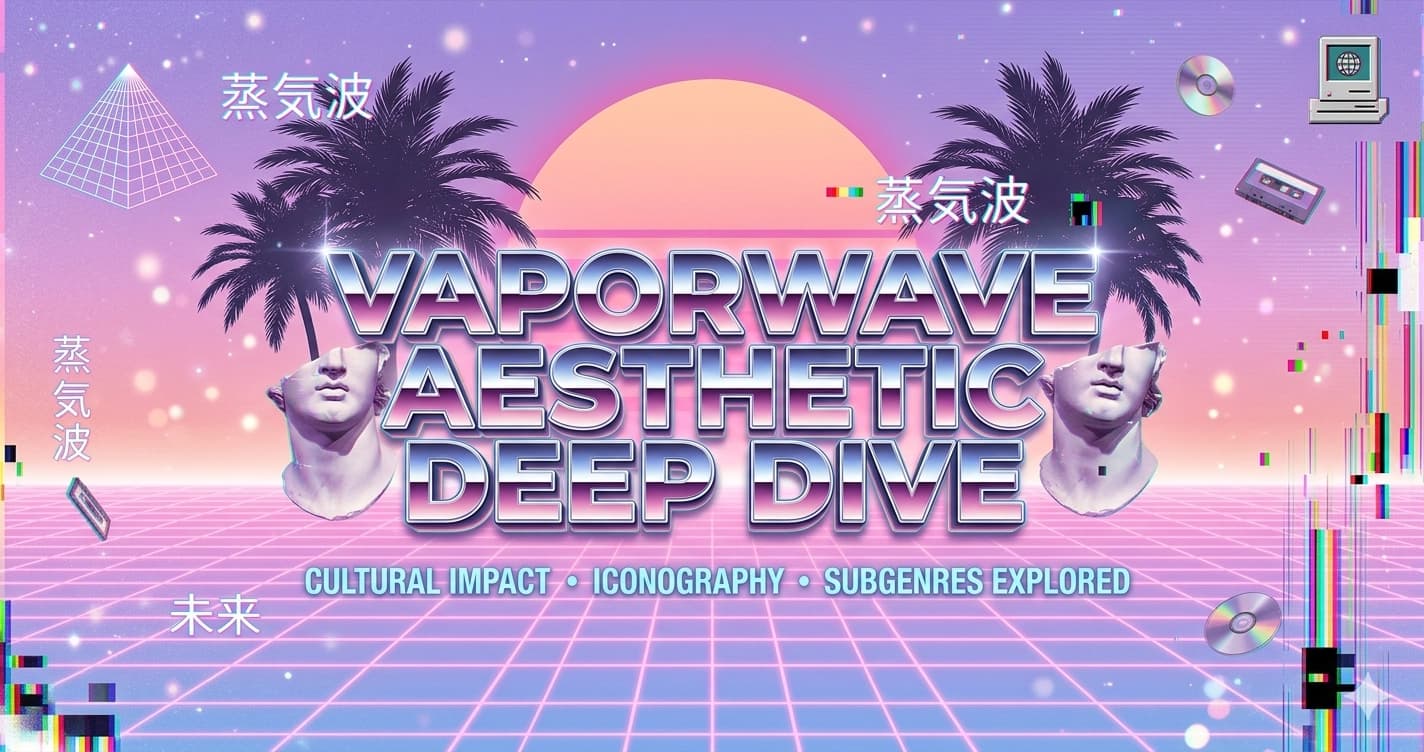
Vaporwave Aesthetic — The Complete History of the Font, the Music, and Why It Never Dies
A E S T H E T I C. The wide-spaced characters in that word are the visual signature of an internet aesthetic that began as a music genre, became a visual movement, spawned a thousand parody accounts, was repeatedly declared dead, and keeps coming back.
Vaporwave is one of the few internet aesthetics with a traceable origin story, a coherent visual logic, and a genuine cultural argument embedded in its design choices. Understanding what it actually is — not just what it looks like — is why it still works as a visual language in 2026.
What Vaporwave Actually Is
Vaporwave started as music, not design.
In 2010–2012, a loosely connected group of producers began releasing music online — primarily on Bandcamp and Tumblr — that combined slowed-down, pitch-shifted samples of 1980s and early 1990s smooth jazz, elevator music, R&B, and corporate ambient music with synthesizer elements borrowed from early video game soundtracks and TV shopping channel background audio.
The intent was ironic. The music sounded like a dream sequence in a mall from 1987 — the aspirational commercial world of early consumer capitalism, heard through a warped, half-remembered filter. Artists including Macintosh Plus (Ramona Xavier), James Ferraro, and later 猫 シ Corp. and Hong Kong Express developed a sound that was both nostalgic and uncanny.
The genre's name — vaporwave — referenced vaporware, the tech industry term for products announced but never released. The music was, in some interpretations, the soundtrack to products that never existed in a consumer utopia that never quite arrived.
The Visual Language
The music needed album art, and the album art created the aesthetic.
Early vaporwave visuals drew from a specific bank of imagery:
Classical statuary — Greek and Roman marble sculpture, often the head of Hermes or a Roman bust, photographed against consumer backgrounds or digitally placed in virtual environments. The juxtaposition of ancient Western aesthetic ideals with late-capitalist consumer spaces.
Early computer interfaces — Windows 95/98 error messages, early 3D rendering, pixel art, scan lines, and the particular visual quality of early CD-ROM era graphics. Digital imagery from an era when digital felt new and slightly magical.
Japanese signage and typography — Hiragana, katakana, and kanji incorporated into designs, often without grammatical coherence from an English perspective. Japan represented a specific version of late-capitalist consumer culture — Sony Walkmans, pachinko parlors, neon-lit shopping streets — that figured heavily in vaporwave's imagined world.
Pastel color palettes — Specific shades: hot pink, cyan, purple, teal. Often with gradients between them. The colors of early digital design before color management was a standard practice.
Widescreen grid environments — Infinite checkerboard floors extending to a digital horizon, often with a sunset gradient. The visual space of early 3D rendering.
Full-Width Text: The Typography of Vaporwave
The typographic signature of vaporwave is full-width text — characters spaced wide, each one occupying the same horizontal space as a full-width CJK (Chinese-Japanese-Korean) character.
In Unicode, these characters come from the Fullwidth Latin Letters block (U+FF21–U+FF3A for uppercase, U+FF41–U+FF5A for lowercase). They were originally included in Unicode to provide Latin character equivalents that would align correctly with CJK characters in contexts where both scripts appear together — primarily in Japanese and Chinese desktop publishing and word processing.
The visual result: A E S T H E T I C. Wide, evenly spaced, slow.
Why this typography works for vaporwave's aesthetic argument:
The pacing of full-width text feels deliberate in a way that normal-width text doesn't. It takes more time to read, more space to render, more visual attention per word. In a media environment of fast, compressed, efficient communication, full-width text moves at a different speed. It has the temporal quality of mall music from 1987 — unhurried, spacious, slightly too much.
The full-width characters also reference CJK typography — connecting the text visually to the Japanese cultural elements that run through vaporwave's visual vocabulary.
Vaporwave vs. Y2K: What's the Difference?
Both vaporwave and Y2K draw from the 1980s–early 2000s technology aesthetic, and they're frequently conflated. They're related but distinct:
| Dimension | Vaporwave | Y2K |
|---|---|---|
| Origin | 2010–2012 music genre | Design trend, late 1990s–2000s |
| Revival | Ongoing (never quite died) | TikTok wave 2021–present |
| Era referenced | 1980s–early 1990s | Late 1990s–early 2000s |
| Technology feel | Early consumer digital; slightly uncanny | Chrome, Y2K bug, millennium optimism |
| Color palette | Pastel pink, cyan, purple, teal | Neon, chrome, holographic, saturated |
| Typography | Full-width, spaced out, slow | Bubble, chrome, 3D, bold |
| Emotional tone | Ironic nostalgia; melancholy | Digital optimism; futurism |
| Cultural critique | Anti-consumerist (implicit) | Celebratory of consumer tech |
| Platform home | Tumblr origin; TikTok/Discord now | TikTok dominant |
The key philosophical difference: vaporwave was originally ironic about consumer capitalism — the music sounds like the background to a world that promised everything and delivered hollow commodities. Y2K aesthetic is largely celebratory of that era — it's nostalgia without the critique.
In practice, the aesthetics have blurred in the TikTok era. Many profiles and creators mix elements of both. The distinction matters more for understanding the original cultural logic than for everyday aesthetic use.
The Cyclical Return of Vaporwave
Vaporwave has been declared dead approximately once every eighteen months since 2014. It keeps coming back. Why?
The generational mechanism: The teenagers and young adults who discovered vaporwave in 2012 are now in their late twenties and thirties. They bring the aesthetic with them as they age into creative roles. New waves of younger users discover it through platforms like TikTok, where vaporwave content surfaces alongside Y2K and Cottagecore.
The nostalgia layer: Vaporwave already had nostalgia built into its DNA — it was nostalgic when it was new. That nested nostalgia (nostalgia for a time that was itself nostalgic) gives it unusual staying power. Each new wave of engagement can add another layer.
The visual toolkit: The vaporwave visual language — specific colors, specific typographic choices, specific imagery — is robust and recognizable. It's a coherent design system that new creators can pick up and immediately use to produce content that signals membership in the aesthetic.
The ironic escape hatch: Vaporwave's ironic origins mean it can be used sincerely or ironically without losing its identity. You can make vaporwave content that's serious about the aesthetic, or you can make content that jokes about vaporwave aesthetics, and both feel true to the original spirit.
Vaporwave in Practice: Platform Guide
TikTok
Full-width text in bios and display names signals aesthetic alignment. TikTok's visual format — short vertical video — is well-suited to vaporwave visual elements (pastel gradients, slow panning shots, synthesizer music).
TikTok character limits:
- Bio: 160 characters
- Display name: 30 characters (Unicode supported)
- Username: 24 characters (plain only)
A vaporwave TikTok display name: aesthetic girl (full-width, lowercase)
Vaporwave is slightly less native to Instagram's photographic format, but works well for accounts posting digital art, graphic design, or aesthetic edits. Full-width text in bios is distinctive against Instagram's standard display.
Instagram bio character limit: 150 characters. Full-width characters count as 1 character each.
Discord
Vaporwave aesthetics are common in retro-gaming, lo-fi music, and aesthetic-focused Discord servers. Full-width server names and role names read clearly against Discord's dark interface.
Discord display name limit: 32 characters. Full-width characters count as 1 each (but take more visual space — plan accordingly).
Twitter / X
The 280-character tweet limit and 50-character display name make Twitter well-suited for full-width vaporwave text. The wide characters read distinctively in the feed.
The Unicode Behind the Aesthetic
The technical implementation of vaporwave text is simple: the Fullwidth Latin Letters Unicode block (U+FF01–U+FF5E) provides full-width versions of standard ASCII punctuation and Latin letters.
Uppercase fullwidth Latin: A B C D E F G H I J K L M N O P Q R S T U V W X Y Z
Lowercase fullwidth Latin: a b c d e f g h i j k l m n o p q r s t u v w x y z
Fullwidth space: (U+3000, IDEOGRAPHIC SPACE) — wider than standard space, used between vaporwave words
The characters are supported on all modern platforms and devices. They copy-paste correctly from any generator into any platform's text field.
Character count note: Full-width characters count as 1 character against platform limits, same as standard characters. However, they render visually wider — a 10-character vaporwave word takes roughly the horizontal space of 15–18 standard characters on screen. Plan bio and display name layouts with this in mind.
Vaporwave Color Palette Reference
For creators building vaporwave visual content:
| Color | Hex | Role |
|---|---|---|
| Vaporwave pink | #FF71CE | Primary accent |
| Cyan / electric blue | #01CDFE | Secondary accent |
| Purple | #B967FF | Background or secondary |
| Teal / mint | #05FFA1 | Highlight |
| Deep purple | #6B2FBB | Dark background |
| Near-black | #1A0533 | Deep background |
| White | #FFFFFF | Text on dark |
These six colors, in gradients or flat applications, cover the core vaporwave palette. Combined with fullwidth text, marble bust imagery, and early-3D grid environments, they produce content that reads as vaporwave on any platform.
For a quick practical guide on how to use vaporwave text in social media bios and posts, see Vaporwave Aesthetic Text — What It Is and How to Use It.
Generate Vaporwave Text
Type any word or phrase in Lettertype's Vaporwave Generator and copy full-width Unicode text directly. Works in Discord display names, Instagram bios, TikTok display names, Twitter profiles, and any platform supporting Unicode — no app, no account, no download.
For the full range of Unicode styled text styles — including Bubble, Bold Cursive, Gothic, Small Caps, Monospace, and more — Lettertype's full generator generates and copies all styles at once.