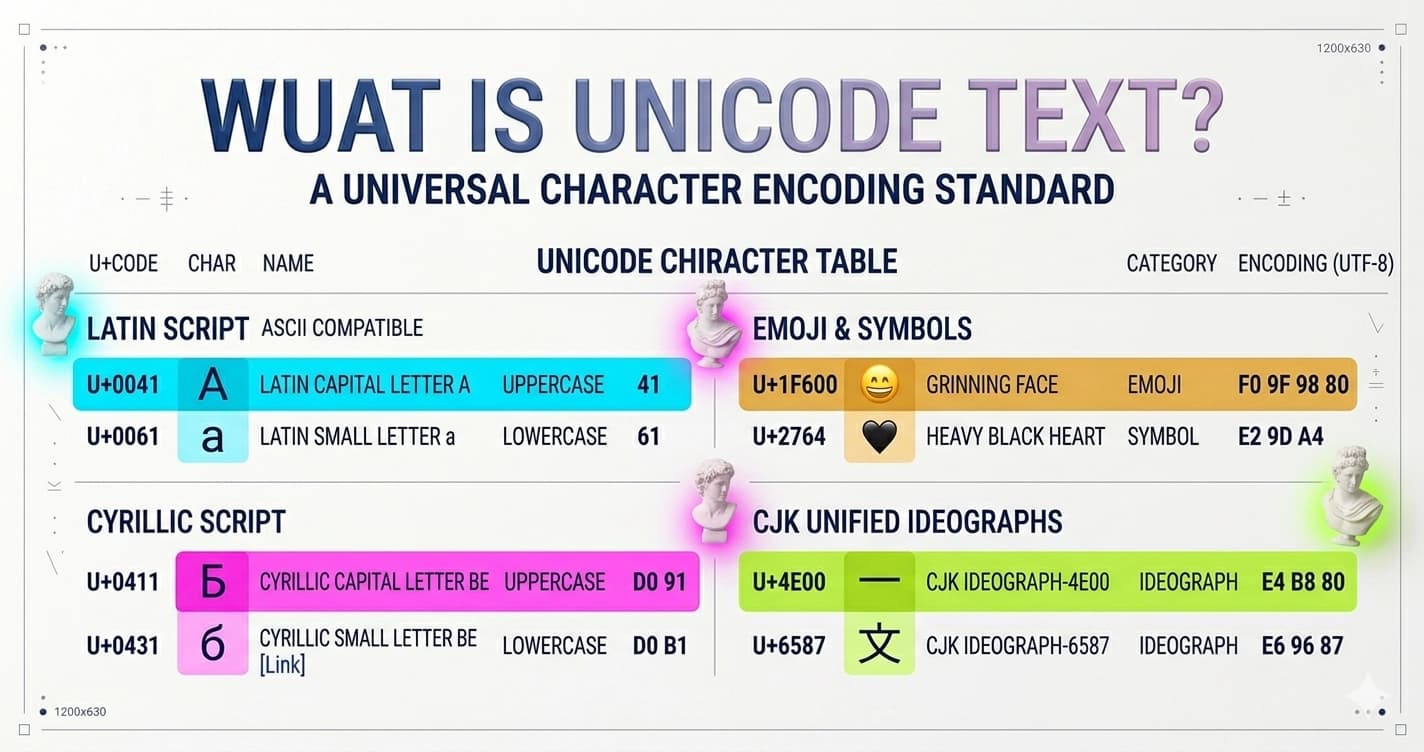
What Is Unicode Text? The Complete Guide to How Styled Fonts Work Everywhere
You've seen it everywhere — flowing cursive names on Instagram, gothic Discord usernames, wide spaced-out text on TikTok bios. None of them installed a special font. They copied and pasted text that already looks different, and it works on every platform they paste it into.
This is Unicode. Not a font trick, not a hack — a fundamental property of how text encoding works in the modern internet.
Here's the complete explanation: what Unicode is, why it includes entire styled alphabets, which specific blocks power the text you see, and what the actual limitations are.
The Problem Unicode Solved
Before Unicode, there was chaos.
In the early decades of computing, different countries, companies, and systems used different encoding standards to represent text. ASCII (1963) defined 128 characters — enough for English text, basic punctuation, and control characters. Extended ASCII variants added characters for other Western European languages. But Japanese computers used Shift-JIS. Korean computers used EUC-KR. Chinese systems used GB2312. The Middle East used EBCDIC variants. None of these systems were compatible.
A document created on a Japanese system displayed as garbage on an American system. International email was unreliable. Software localization required maintaining separate code paths for every language.
The Unicode Consortium was formed in 1991 with a specific mission: one universal standard that assigns a unique number — called a code point — to every character in every writing system in the world, past and present. One code point, one character, one global meaning, regardless of what system reads it.
Unicode 1.0 launched in 1991 with 7,161 characters. Unicode 15.1 (2023) contains 149,813 characters covering 161 scripts, plus thousands of symbols, emoji, and specialized technical characters.
The relevant sections for styled text generators: the Mathematical Alphanumeric Symbols block, which takes up 996 code points and contains entire styled alphabets that happen to look like font variants of the Latin alphabet.
Code Points, Encoding, and UTF-8
Understanding Unicode requires a brief detour into how it actually stores characters.
A code point is just a number. The letter A is U+0041. The letter é is U+00E9. The Gothic character 𝔊 is U+1D50A. The code point is abstract — it's the identity of a character, not the bytes that store it.
Encoding is how code points are stored as bytes in files and transmitted across networks. Unicode defines several encoding formats:
UTF-8 is the dominant encoding on the web. It's variable-length: ASCII characters (U+0000–U+007F) use 1 byte each. Characters up to U+07FF use 2 bytes. Characters up to U+FFFF use 3 bytes. Characters above U+FFFF (the Supplementary Multilingual Plane, where most styled Unicode alphabets live) use 4 bytes.
When you paste 𝓑𝓸𝓵𝓭 𝓒𝓾𝓻𝓼𝓲𝓿𝓮 into Instagram's bio field, you're pasting a series of 4-byte UTF-8 sequences. Instagram's servers store those bytes. When another user loads your profile, their device requests those bytes, decodes them into code points, and renders the characters using whatever system font their device uses to support those code points.
No font file. No special rendering configuration. Just bytes that mean specific characters.
The Mathematical Alphanumeric Symbols Block
The Unicode Mathematical Alphanumeric Symbols block (U+1D400–U+1D7FF) is the source of most styled font text you see on social media.
The block was designed for mathematical notation, not social media. The problem it solved: in formal mathematics, the same letter in different typographic styles denotes different mathematical objects. An italic x might be a variable. A bold x might be a vector. A double-struck ℝ denotes the set of real numbers. These are not stylistic choices — they're semantic distinctions. A reader who confuses them misreads the mathematics.
In print, typographers handle these distinctions. In plain text (email, forums, digital communication), there was no way to mark these distinctions without resorting to workarounds like writing \mathbb{R} in LaTeX.
Unicode 3.1 (2001) solved this by encoding entire alphabets in each style as distinct code points. The result: 996 code points covering the following styles:
| Style | Unicode Range | Example | Mathematical Use |
|---|---|---|---|
| Mathematical Bold | U+1D400–U+1D433 | 𝐀𝐁𝐂 | Vectors, matrices |
| Mathematical Italic | U+1D434–U+1D467 | 𝐴𝐵𝐶 | Variables |
| Mathematical Bold Italic | U+1D468–U+1D49B | 𝑨𝑩𝑪 | Bold variables |
| Mathematical Script | U+1D49C–U+1D4CF | 𝒜ℬ𝒞 | Function spaces, operators |
| Mathematical Bold Script | U+1D4D0–U+1D503 | 𝓐𝓑𝓒 | Bold operators |
| Mathematical Fraktur | U+1D504–U+1D537 | 𝔄𝔅ℭ | Lie algebras, some physics |
| Mathematical Double-Struck | U+1D538–U+1D56B | 𝔸𝔹ℂ | Number sets (ℕ, ℤ, ℝ) |
| Mathematical Bold Fraktur | U+1D56C–U+1D59F | 𝕬𝕭𝕮 | Bold Fraktur |
| Mathematical Sans-Serif | U+1D5A0–U+1D5D3 | 𝖠𝖡𝖢 | Some logic notation |
| Mathematical Sans-Serif Bold | U+1D5D4–U+1D607 | 𝗔𝗕𝗖 | Bold sans-serif |
| Mathematical Monospace | U+1D670–U+1D6A3 | 𝙰𝙱𝙲 | Code in math papers |
Mathematicians needed these distinctions to be unambiguous in digital text. The side effect: every one of these alphabets looks like a styled font variant of the Latin alphabet, and because they're Unicode, they work anywhere Unicode text is supported.
Other Unicode Blocks for Styled Text
Beyond the Mathematical block, Unicode text generators draw on several other blocks:
Fullwidth Latin (U+FF01–U+FF60)
The Fullwidth Latin Letters block contains full-width versions of ASCII characters designed to align with CJK (Chinese-Japanese-Korean) characters in East Asian typography contexts where both Latin and CJK text appear on the same line.
Full-width Latin letters occupy the same horizontal space as a CJK character — visually wider and more evenly spaced than standard ASCII. This is the source of Vaporwave text: A E S T H E T I C.
Enclosed Alphanumerics (U+2460–U+24FF) and Supplement (U+1F130–U+1F189)
These blocks contain circled and enclosed letters and digits:
- Ⓐ Ⓑ Ⓒ (U+24B6–U+24CF) — circled Latin letters (lowercase: ⓐ ⓑ ⓒ)
- 🄰 🄱 🄲 (U+1F130–U+1F149) — negative squared Latin capital letters
- 🅰 🅱 🅲 (U+1F170–U+1F189) — negative circled Latin capital letters (filled bubble)
These are the source of Bubble text (ⓑⓤⓑⓑⓛⓔ) and Square text (🅂🅀🅄🄰🅁🄴).
Phonetic Extensions (U+1D00–U+1D7F) and Spacing Modifier Letters (U+02B0–U+02FF)
These blocks contain small caps and phonetic characters used in linguistic transcription:
- ᴀ ʙ ᴄ ᴅ ᴇ — small capital letters from the International Phonetic Alphabet
These are the source of Small Caps text: ꜱᴍᴀʟʟ ᴄᴀᴘꜱ.
Combining Diacritical Marks (U+0300–U+036F)
These are modifier characters — they don't occupy space themselves but attach to the preceding character. Stacking multiple combining marks on a single character produces the distinctive "glitchy" or "Zalgo" aesthetic (T̵̡͙̦̱e̴̻͙x̵͉t̷̫͠).
Why Unicode Styled Text Works "Everywhere"
The question people ask most often: why does this work on Instagram, TikTok, Discord, Twitter, and email without any app?
The answer is that these characters are part of the Unicode standard, and every modern text system implements Unicode. When you paste styled Unicode text into any platform's text field:
- Your clipboard contains the UTF-8 encoded bytes for the Unicode characters
- The text field receives those bytes and stores them as-is
- When the text is displayed, the rendering system looks up each code point and finds the glyph in the installed system fonts that provides that character
- All modern operating systems (iOS, Android, macOS, Windows, Linux) ship with system fonts that cover the Mathematical Alphanumeric Symbols block
The platforms themselves do nothing special. They treat styled Unicode text the same as any other Unicode text — which is to say, they just store and display it.
Rendering consistency: The visual appearance varies slightly between platforms and operating systems because different system fonts render the same code points differently. A Mathematical Bold Script A (𝓐) may look slightly different on iOS vs. Android vs. Windows, depending on which system font is used. But the character will be recognizable on all of them.
Platform-by-Platform Unicode Support
| Platform | Styled Unicode in Profiles | Notes |
|---|---|---|
| Yes | Name field, bio; verified badges may interact oddly with styled names | |
| TikTok | Yes | Display name (30 chars), bio (80 chars) |
| Twitter / X | Yes | Display name (50 chars), bio (160 chars), tweets |
| Discord | Yes | Display name (32 chars), bio (190 chars), messages |
| Yes | Headline, About section; use conservatively for professional credibility | |
| Partial | Styled text in posts; name field restrictions more aggressive | |
| YouTube | Yes | Channel name, About section |
| Yes | Username display, posts, comments | |
| Slack | Yes | Display name, status, messages |
| Telegram | Yes | Name, bio, messages |
| Yes | Status, messages | |
| Email (Gmail) | Yes | Body text, signature; some email clients may fall back to system fonts |
| Google Docs | Yes | Full Unicode support |
| Notion | Yes | Full Unicode support |
The practical conclusion: if a platform accepts text input and uses a modern rendering stack, Unicode styled text will work. Exceptions are rare and getting rarer as old systems are updated.
Limitations You Should Know
Accessibility
Screen readers — used by blind and low-vision users — interpret Unicode characters by their Unicode name, not their visual appearance. A Mathematical Bold Script A is named "MATHEMATICAL BOLD SCRIPT CAPITAL A" in the Unicode standard. A screen reader following the Unicode names would read "𝓗𝓮𝓵𝓵𝓸" as "mathematical bold script capital H, mathematical bold script small e, mathematical bold script small l, mathematical bold script small l, mathematical bold script small o."
This is a real accessibility barrier. For content where accessibility matters, use plain text. For profile bios where the primary use is visual identity, the trade-off is a judgment call.
Search and Indexing
Search engines and platform search algorithms may or may not normalize Unicode styled characters to their plain equivalents for matching purposes. A display name of "𝓐𝓵𝓮𝔁" may not surface in a platform search for "Alex." For any context where discoverability by name or keyword is important, test whether your styled text is indexed as its plain-text equivalent before committing to it.
Missing Characters
The Mathematical Alphanumeric Symbols block doesn't include all characters. Notably:
- Some uppercase letters appear in the Letterlike Symbols block (U+2100–U+214F) rather than the Mathematical block for historical reasons — ℂ, ℍ, ℕ, ℙ, ℚ, ℝ, ℤ exist there, while their Mathematical equivalents are missing.
- Numbers and most punctuation don't have Mathematical styled equivalents. Font generators either use approximations (regular numbers) or skip these characters.
- Some less common letters have incomplete coverage.
Older Devices
Devices with operating systems older than ~2015 may not have system font coverage for the Supplementary Multilingual Plane (characters above U+FFFF, including most Mathematical Alphanumeric Symbols). These devices will display replacement characters (□ or ?) instead of the styled letters. This affects a very small and declining fraction of users.
Copy-Paste Context Loss
When Unicode styled text is copied into applications that convert to plain text (some note-taking apps, form fields that strip Unicode, older CMS systems), the styled characters may be stripped or replaced. Always test in the target context before assuming the styling will survive.
How Unicode Font Generators Work
A Unicode font generator takes a character you type and maps it to the equivalent character in a specific Unicode block. The mapping is a simple lookup table:
- Input:
A(U+0041) - Bold output:
𝐀(U+1D400) - Bold Italic output:
𝑨(U+1D468) - Script output:
𝒜(U+1D49C) - Gothic output:
𝔄(U+1D504) - Double-Struck output:
𝔸(U+1D538) - Vaporwave output:
A(U+FF21)
The generator does this for each character in your input string, concatenates the results, and presents the output for copying.
The technical implementation can be a few dozen lines of JavaScript: build a mapping object from each plain character to each styled variant, run the input string through the mapping, handle missing characters (punctuation, numbers that have no styled equivalent).
This simplicity is why Unicode font generators proliferated — the core logic is trivial. What differentiates them is the user experience: how many styles are offered, how fast the generation happens, whether it includes copy-to-clipboard functionality, and what additional features (character limits, platform guides, preview) are provided.
The Unicode Standard's Ongoing Evolution
Unicode continues to add new code points. Each new version may include additional styled characters, new scripts, new symbols, or new emoji. The Unicode Consortium reviews proposals submitted by users, academics, and industry stakeholders, and approves additions based on criteria including uniqueness, utility, and compatibility.
The Mathematical Alphanumeric Symbols block is complete and won't be extended — all the mathematical styles that existed at encoding time are represented. But other blocks grow with each release, and emoji updates (the most visible part of each Unicode release) add characters that may develop aesthetic uses similar to the Mathematical blocks.
Generate Every Unicode Style
Every Unicode styled text format described in this guide — Bold, Italic, Bold Italic, Script, Bold Script, Fraktur, Double-Struck, Monospace, Vaporwave, Bubble, Small Caps, and more — is available at Lettertype.
Type any text, see all styles simultaneously, copy any style with one click. Works on every platform that supports Unicode — which is essentially all of them.